
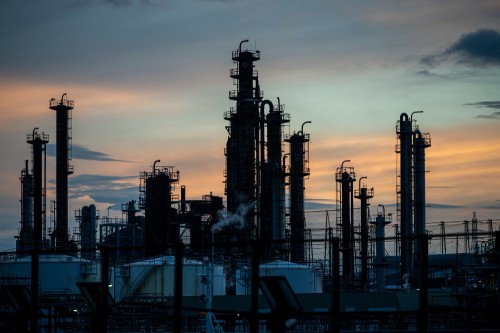
Global markets experienced notable fluctuations on Monday as tensions in the Middle East influenced oil prices and bond yields. Brent crude, a key international oil benchmark, surged by up to 1.77% to $111.16 per barrel, marking its highest point in nearly two weeks. This increase followed an attack on a nuclear facility in the United Arab Emirates, and coincided with the stalling of peace negotiations between the United States and Iran. Former President Donald Trump took to social media, issuing a stern warning to Iran: “For Iran, the Clock is Ticking, and they better get moving, FAST, or there won’t be anything left of them. TIME IS OF THE ESSENCE!” The oil price eventually settled at $110 per barrel after Iran indicated a response to a new US proposal, with discussions ongoing through a Pakistani mediator.
Global bond markets saw heightened volatility, with the benchmark 10-year US Treasury yield climbing to 4.631%, its highest since February 2025, before settling at 4.599%. In the UK, political uncertainty added to the market’s instability. The 10-year gilt yield reached 5.19%, surpassing an 18-year high before easing to 5.15%. Speculation about a potential leadership challenge to Prime Minister Keir Starmer from Manchester Mayor Andy Burnham contributed to the fluctuations. Concurrently, UK Chancellor Rachel Reeves joined G7 finance ministers in Paris to deliberate on the economic repercussions of the Middle Eastern conflict.
Concerns over the UK’s fiscal outlook were heightened by fears of a possible shift to the left in the government’s economic policy. Mohit Kumar, chief economist at Jefferies, highlighted the challenges posed by the UK’s existing fiscal constraints, noting that further public spending increases may be unfeasible without additional revenue-generating measures. Kathleen Brooks, research director at XTB, suggested a potential recovery in UK bond yields if markets perceive a moderation in Burnham’s high-spending approach. She emphasized the importance of the 10-year yield falling below the 5% mark as a key test for UK markets.
In Japan, government bond yields also rose, with the 10-year yield reaching nearly 2.8%, the highest in almost 30 years. This increase was driven by the government’s plans to issue new debt to mitigate the economic impact of the Middle Eastern conflict. Meanwhile, European stocks opened lower, with the Stoxx Europe 600 index declining by 0.7%, while the UK’s FTSE 100 remained relatively stable.
Asian markets showed mixed results, with Japan’s Nikkei index falling by approximately 1%. Hong Kong’s Hang Seng index also decreased by 1%, while Shanghai’s SSE Composite slipped slightly by 0.1%. In contrast, South Korea’s Kospi index closed 0.3% higher, reflecting varied investor sentiment across the region.
